
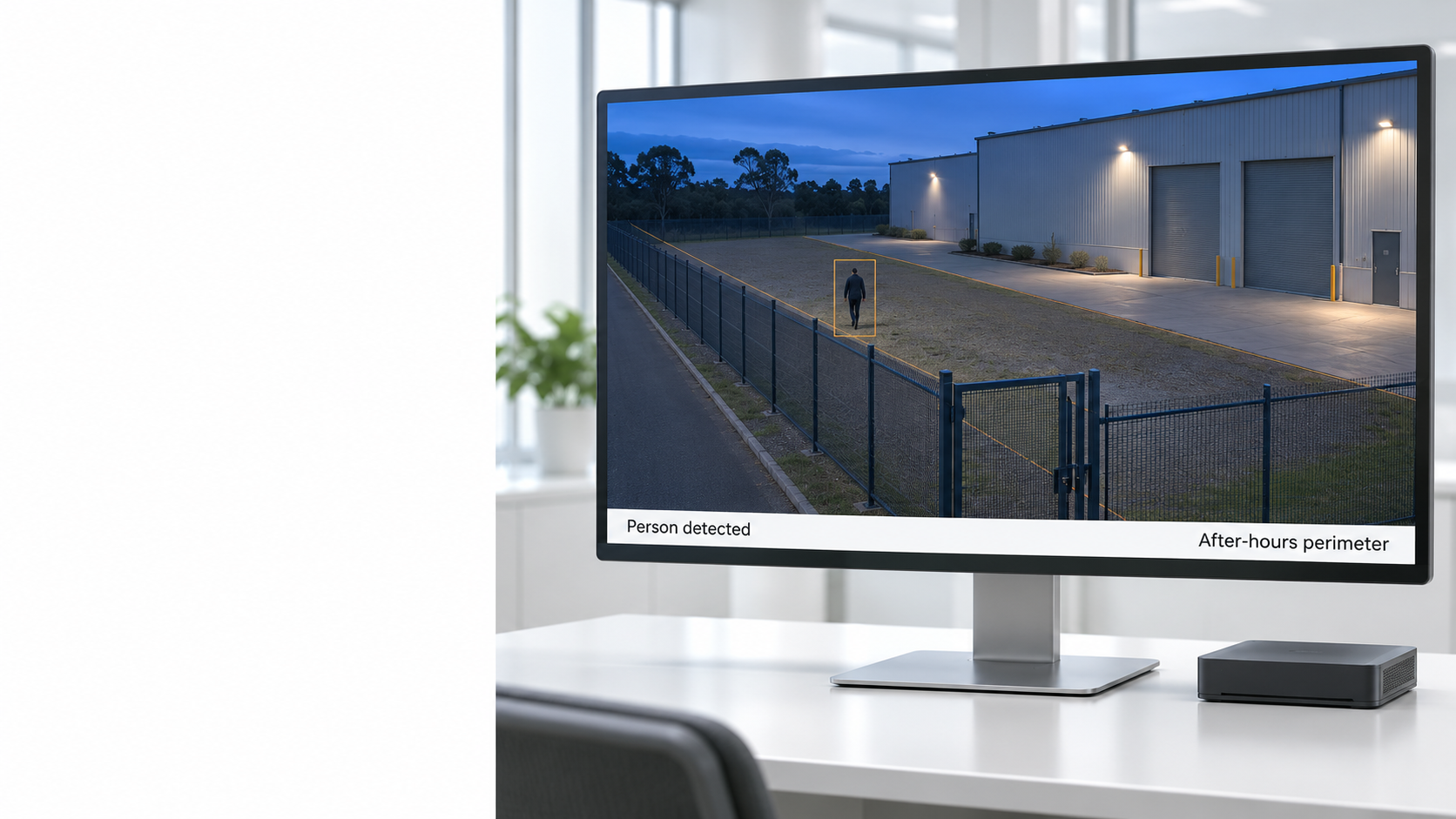
Guards cannot watch every fence line, and ordinary motion sensors raise alarms for leaves, rain and insects. After a while, nobody trusts the alarm. Analytics that understand what they are looking at fix that.
What is AI perimeter protection?
It is video analytics that detect people, vehicles and objects around the edge of a site, and apply rules to decide what is worth an alert. The cameras you already have become sensors for intrusion, loitering and unusual activity.
How is it different from motion detection?
Motion detection reacts to any pixel change. AI detection identifies what moved. That means no alarm for a swaying tree or a stray animal, and an alert when a person is in a zone where nobody should be.
| Basic motion detection | AI person and object detection | |
|---|---|---|
| Triggers on | Any pixel change | A person, vehicle or defined object |
| False alarms from weather and shadows | Common | Far fewer |
| Rules by time and context | Limited | Yes (for example a lone person at night) |
| Alert includes | A clip, sometimes | Snapshot, alert type, location and details |
What rules can you set?
FaceTagr's person detection supports custom rule logic. Typical scenarios include a lone person on site at night, sudden crowding at a gate, an abandoned bag, smoke, or mobile phone use in a restricted area. Because the platform tracks custom objects and scenarios, you can match the rules to your site.
Can it combine perimeter alerts with face recognition?
Yes. A person detected at the perimeter can also be checked against your whitelist and blacklist. An unknown face at 2 a.m. is a different alert from a known contractor.
Does it work without a reliable connection?
Yes. Analytics run on an edge unit at the site, so detection and alerts continue during network outages, and it can run on-premises. Alerts reach your team through the dashboard, mobile app or SMS when connected.
What hardware do you need?
FaceTagr connects to your existing cameras through the NBOX edge unit, which runs on lean hardware. NBOX is starting from ₹5 Lakhs (~$6,000 USD). Place cameras so that fence lines, gates and approaches are covered with good lighting, and ask for a site survey if you are unsure.
What are the limits?
No analytics system is perfect. Heavy rain, fog, very low light and poor camera placement reduce accuracy. Treat alerts as a trigger for a person to verify and respond, and test the system on your own site before you rely on it.
Where is it used?
Factories, warehouses, solar and power sites, construction yards, campuses, data centres, temples and other public places have all used edge video analytics to cover areas that guards cannot watch full-time.
The takeaway
A perimeter system is only as good as the alerts people still trust. Fewer, better alerts mean faster response. Want to test it at your site? Use the enquiry form below.