
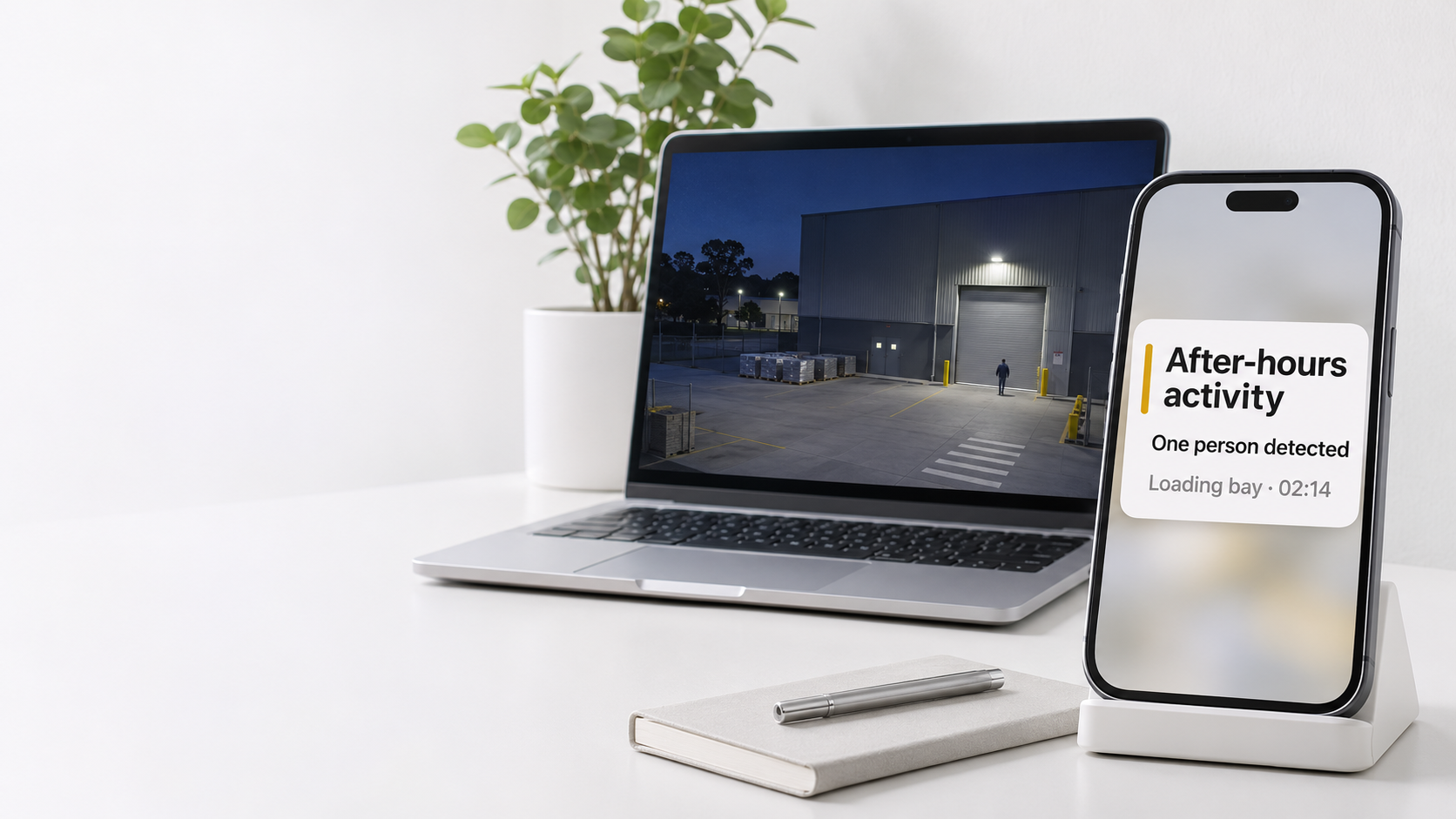
Most security teams do not have too little data. They have too many alerts, and the important one is buried among hundreds of false ones.
What is a context-aware alert?
It is an alert triggered by a situation, not just an event. Instead of "motion detected on camera 14", you get "unknown person detected in loading bay after hours". The context (identity, activity, location and time) is what makes it useful.
Why does alert fatigue happen?
Simple triggers such as motion, loud noise or a person crossing a line fire all day. Operators learn to ignore them, and real incidents slip through. Fewer, richer alerts get a faster response.
Which signals can be combined?
| Signal | Example |
|---|---|
| Who | Known staff member, blacklisted person or unknown face |
| What | Person, weapon, abandoned bag, smoke, phone in a restricted area |
| Where | Gate, server room, stockroom, fence line |
| When | After hours, during a shift change, on a holiday |
| How many | A lone person, or sudden crowding |
What are examples of context-aware rules?
- A lone person on site at night
- Sudden crowding at an entrance
- An abandoned bag in a public area
- Smoke detected in a storage area
- A mobile phone in a zone where phones are not allowed
- A barred person or an unknown face at a staff-only door
Can you write the rule in plain language?
Yes. FaceTagr's alert workflow includes NotionTag IQ, an embedded model that lets you define scenarios and alert rules by prompt. You describe what you want to be told about, for example "someone in the cold store after closing time", and the platform applies it to your cameras. Test any new rule on recorded footage before you rely on it.
Where do the alerts go?
To configurable dashboards and, when cloud-connected, the iOS or Android app with a snapshot, alert type, location and details, and by SMS. Different rules can go to different people, so facilities, security and management each see what is theirs.
Does it need the cloud?
No. Detection and rules run at the edge, next to your cameras, so alerts keep working during an outage and video does not have to leave the site. It can be hosted on-premises, in your cloud or in-country.
How do you measure whether it is working?
Track the number of alerts per day, the share your team marks as useful, the time from event to response, and the incidents you found only after the fact. Review rules monthly and tune them.
How much does it cost?
Costs scale with cameras and sites, and lean edge hardware keeps the starting point practical. NBOX is starting from ₹5 Lakhs (~$6,000 USD). Contact us for a quote.
The takeaway
Good security is not more alerts. It is the right alert, to the right person, with enough context to act. Want to try a rule on your own cameras? Use the enquiry form below.