Most sites already have cameras. What they lack is someone watching every screen. Face recognition turns passive recording into live alerts.
What is CCTV face recognition?
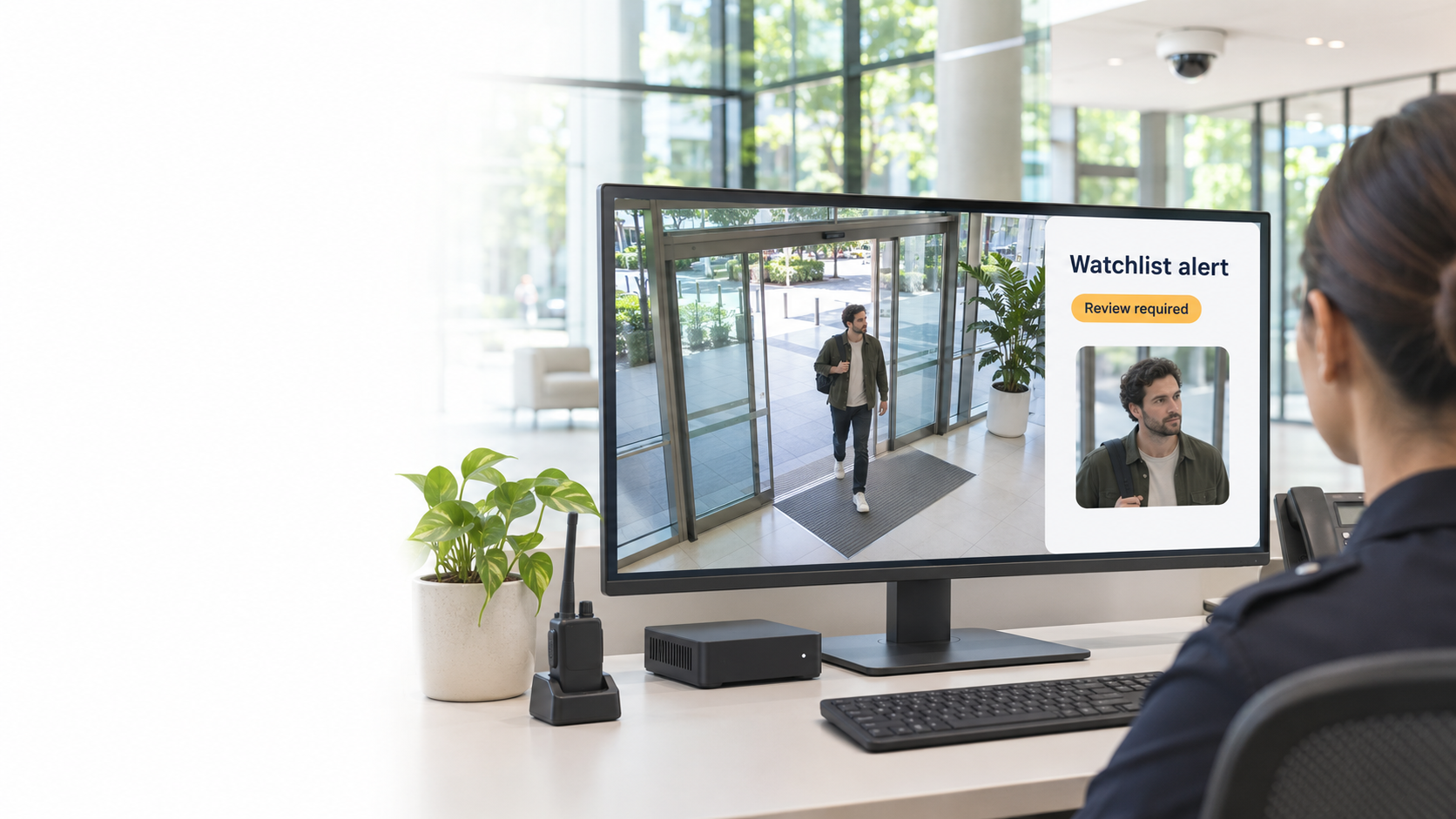
It is software that detects faces in a live camera feed, converts each into a template and compares it with an enrolled list. When a face matches, the system raises an alert with the camera, time and person details. Without a match, no alert is created.
What are whitelist and blacklist alerts?
A blacklist (watchlist) alert fires when a person of concern appears, for example someone barred from a venue, a known offender or a former employee. A whitelist alert recognises authorised people, such as staff, contractors or VIPs, so you can greet them, log them or open a gate, and flag everyone else.
Can it work with the cameras we already have?
Yes, in most cases. FaceTagr's NBOX is a dedicated edge hardware-software unit that connects to your existing CCTV streams over RTSP or ONVIF and runs recognition at the site. Camera angle, resolution and lighting still affect results, so we recommend a site survey for entrances and choke points.
Does it need the cloud?
No. Processing happens on the edge unit, so the system keeps working when the internet is down and video does not have to leave the site. It can run on-premises and even air-gapped, as in our Indian Army deployment. When connected, alerts reach your dashboard, the iOS and Android app (with a snapshot, alert type and location) and SMS.
How accurate is face recognition on CCTV?
CCTV is harder than a phone selfie because of distance, angles, motion and lighting. FaceTagr's algorithms are NIST FRTE tested: 99.71% found at first rank among 12 million identities (NIST FRTE 1:N). They have been used across varied skin tones and camera quality in India, the Middle East, Africa and Australia. For high-stakes decisions, treat an alert as a prompt for a trained person to verify, not as proof.
Where is CCTV face recognition used?
- Airports and transport hubs
- Retail, hospitality and entertainment venues
- Corporate campuses, factories and warehouses
- Residential and educational campuses
- Government and defence sites
What about privacy and the law?
Rules for live face recognition in public or semi-public spaces differ widely (GDPR and local law in Europe and the UK, BIPA in Illinois, the Privacy Act in Australia, the UAE PDPL, India's DPDP Act), and some places restrict it heavily. Define a lawful purpose, display notices, limit who can see alerts, set retention periods and take legal advice before deployment. Keeping processing at the edge helps you store less.
How much does it cost?
Because the NBOX runs on lean hardware, you scale by cameras rather than by buying servers. NBOX is starting from ₹5 Lakhs (~$6,000 USD). Contact us with your camera count and sites for a quote.
The takeaway
Your cameras already see everything. Face recognition makes them tell you what matters, as it happens. Want a site assessment? Use the enquiry form below.