Teams in India, the Middle East, Africa, Australia and Europe all hit the same wall with cloud face checks: the connection drops, the queue grows and someone asks where the faces are stored. Edge processing removes all three problems at once.
What is on-device (edge) face recognition?
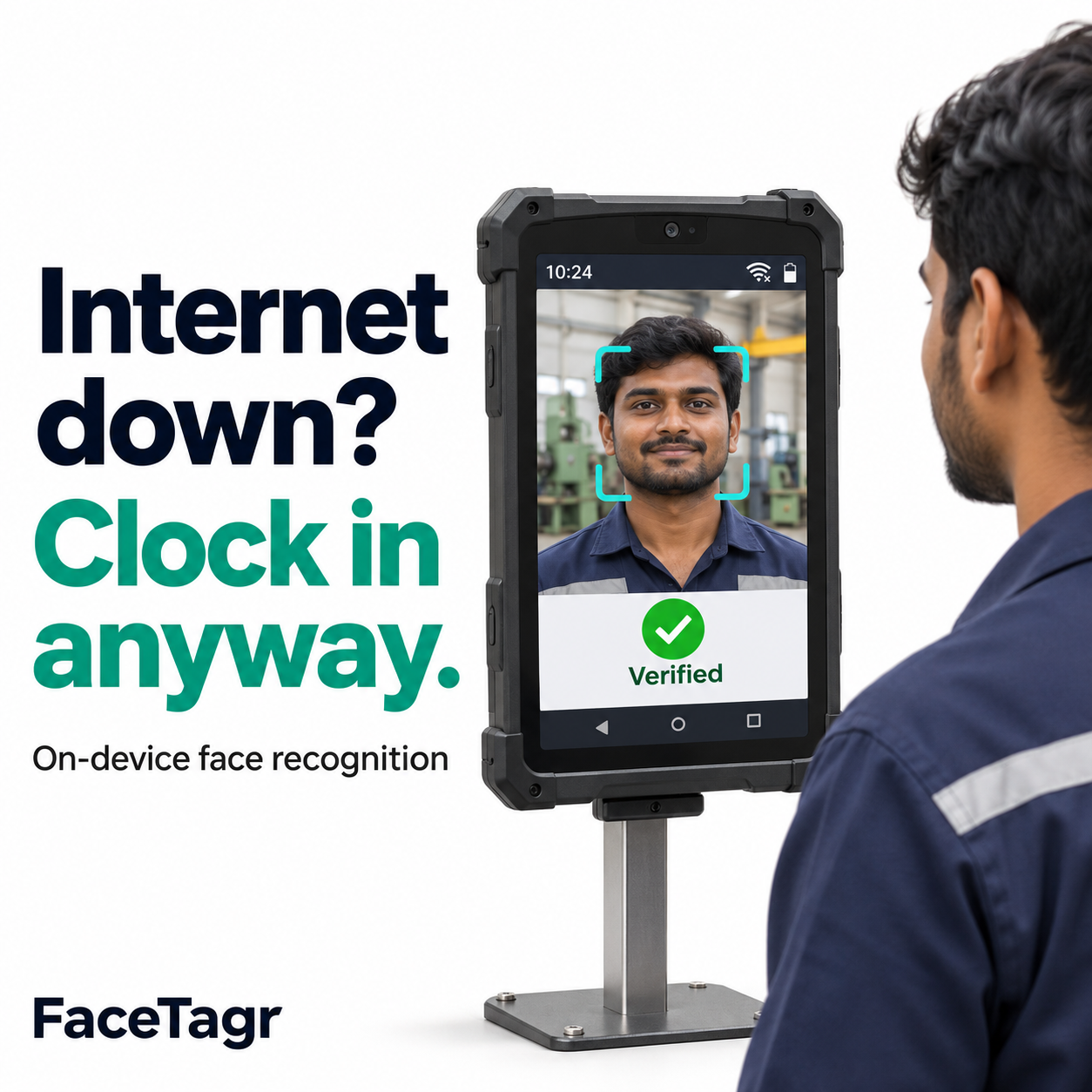
Edge face recognition runs detection, matching and liveness checks on the device in the user's hand or on the wall. No image has to leave it. The device compares the live face with stored encrypted templates and returns a result in under a second.
How is edge different from cloud face recognition?
Cloud systems send every face image to a remote server and wait for an answer. Edge systems decide locally. The practical differences:
| Cloud-only | Edge (on-device) | |
|---|---|---|
| Needs internet for each check | Yes | No |
| Face images leave the device | Yes | No |
| Speed | Depends on network | Under 1 second |
| Works on remote or air-gapped sites | Rarely | Yes |
| Typical hardware | Proprietary terminals or servers | Standard Android or iOS device, about $100 |
Does face recognition work without internet?
Yes, if matching runs on the device. FaceTagr's SDK verifies people fully offline, stores results for up to 60 days, and syncs attendance data when a connection returns. Our defence deployment with the Indian Army runs air-gapped, and the same engine powers factories, farms, construction sites and school gates.
Is on-device face recognition better for privacy?
It is the simplest way to minimise biometric data. During enrollment a photo is converted into an encrypted face template and the original image is deleted. If you choose to sync, only embeddings and attendance metadata travel, never photos or video. In a fully on-device setup FaceTagr has no access to your data at all.
A note on regulation: privacy laws differ worldwide, including GDPR in Europe and the UK, BIPA in Illinois, the Privacy Act in Australia, the UAE PDPL and India's DPDP Act. They share themes of consent, purpose limitation, security and data minimisation. No face recognition product can make you compliant by itself, because compliance depends on how you deploy and govern it, but keeping data on the device makes those obligations much easier to meet. Speak to your legal adviser about consent and notices for your region.
How accurate is edge face recognition?
Edge does not mean lower accuracy. FaceTagr's algorithms are NIST FRTE tested: 99.71% found at first rank among 12 million identities (NIST FRTE 1:N), and up to 99.91% match rate in NIST FRTE 1:N testing. The same engine has run more than a billion verifications across a wide range of skin tones, lighting conditions and camera qualities.
How much does edge face recognition cost?
Benchmark-grade accuracy should not need premium hardware. The FaceTagr SDK is from $3 per user per year. Liveness included. No per-check fees. It runs on Android 10 or later and 3 GB RAM, so you can start on a tablet that costs about $100. Contact us for a quote at your volume.
Where is edge face recognition used?
- Employee and student attendance, including group check-ins that cut queues
- Exam candidate verification
- Gate and entry systems (integrated with Dormakaba and Magnetic Access)
- Field and remote workforces with unreliable networks
- HR and payroll software that embeds a verification SDK
Can edge systems still be centrally managed?
Yes. When devices connect, you get central dashboards, alerts and reports. Larger customers can host FaceTagr in the cloud of their choice, on-premises, or in-country (for example in Dubai).
The takeaway
Ask every vendor one question: what happens when the internet goes down? With edge-native face recognition, nothing changes, because it never relied on the cloud to work.