Proxy attendance is a problem wherever shifts are paid by the hour: factories, construction sites, farms, warehouses, clinics, schools and retail chains. Cards, PINs and QR codes can be shared. A face cannot.
What is buddy punching?
Buddy punching means one person clocks in or out on behalf of another, usually with a shared card, PIN or fingerprint trick. It inflates paid hours and weakens trust in attendance data, which in turn affects payroll, safety headcounts and compliance records.
Why do cards, PINs and QR codes fail?
They prove that someone holds a token, not that the right person is present. A card can be handed to a colleague, a PIN can be told, and a QR code can be forwarded. Face recognition ties the record to the person.
How does face recognition attendance stop proxy clock-ins?
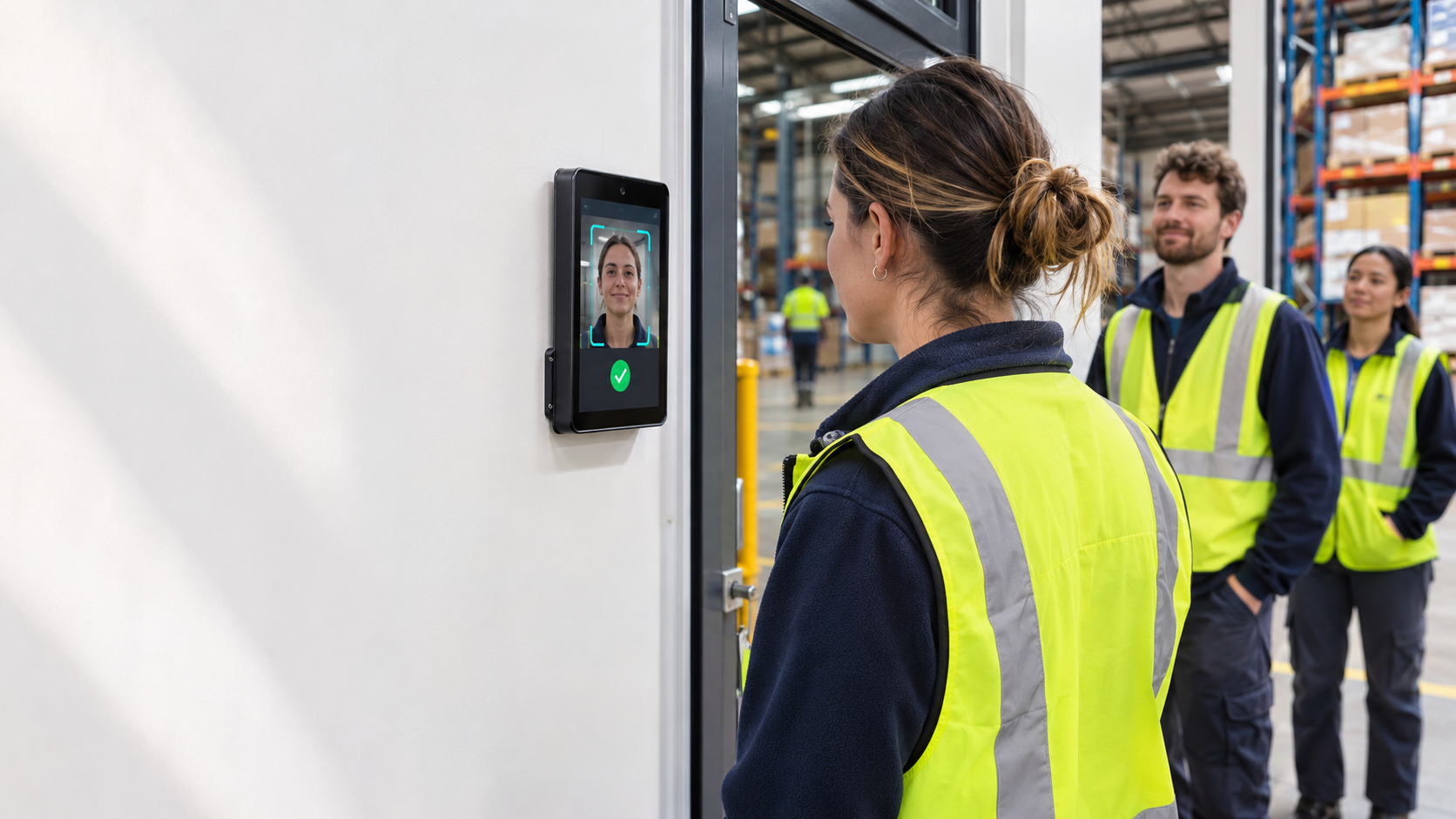
At check-in, the device matches the live face to the enrolled template and confirms liveness. If the face doesn't match, or the camera is shown a photo or video, no attendance is recorded. Every successful check logs time and GPS location, with optional geo-fencing so people can only check in at the site.
Can it handle large teams and shift-change queues?
Yes. Recognition takes under a second, and group check-in (N:N) lets several people be recognised at once, which cuts queues in classrooms and factory gates. In a 1:N setup, people simply look at the camera and are identified from an enrolled gallery of up to 200,000 photos.
Does attendance still work at remote sites with no signal?
Yes. Matching happens on the device, so it works offline. Results are stored for up to 60 days and sync automatically when the device connects, which suits construction, farm, mining and field teams.
What hardware do you need?
No proprietary terminal is required. The FaceTyck app and FaceTagr Edge SDK run on Android 10 or later and 3 GB RAM, so a tablet of about $100 is enough. Teams can also use phones, and the front or back camera.
Will it work with our HR and payroll software?
FaceTagr integrates with HR and payroll platforms including SAP SuccessFactors, Adrenalin, PeopleStrong, ZingHR and PeopleHum. When it is integrated, employees never need a separate portal. Attendance flows into the system your payroll team already uses.
How do we handle employee privacy and consent?
Enrollment converts a photo into an encrypted template and deletes the original. Cloud sync, if used, carries only embeddings and attendance metadata, never photos or video. Biometric laws differ by country (GDPR in Europe and the UK, BIPA in Illinois, the Privacy Act in Australia, the UAE PDPL, the DPDP Act in India), so give employees clear notice and get consent where your region requires it.
How much does it cost?
From $3 per user per year. Liveness included. No per-check fees. A free trial of FaceTyck is available, and our team can quote for your headcount.
The takeaway
If attendance is paid by the hour, proof of presence is worth more than a card swipe. Start with one site, compare the numbers after a month, then scale. Want to pilot it? Use the enquiry form below or start a FaceTyck free trial.